
The Hidden After-Sales Bill: What a Failed Smart Lock Really Costs a Distributor
Every smart lock distributor negotiates the purchase price down to the last dollar. Almost nobody budgets for what happens after the sale — the technician visits, the return shipping, the shelf of spare locks, and the customer who quietly stops calling. This article puts real numbers on the hidden after-sales bill, and shows how a patented key-swappable design is engineered to remove most of it.中文摘要:每个智能锁经销商都会把进货价算到最后一美元,却很少有人细算售后这笔账——上门维修、退换物流、整锁备货,以及那个从此不再联系你的客户。本文用真实数字拆解这笔隐藏的售后账单,并展示专利钥匙换模块设计如何从结构上消掉它的大部分。(正文为英文)
The $50–$150 Line Item Nobody Puts in the Price List
When a conventional smart lock fails in the field, the meter starts running. A technician has to be scheduled, the lock has to come off the door, and the unit either gets repaired on site or shipped back for service. Across the industry, a single incident typically costs $50–$150 once you count labor, transport and logistics — and that is only the visible part of the bill.
Behind the invoice sit the costs that never appear on any quote: the hours your staff spend coordinating the case, the return shipping both ways, the temporary lock on the customer's door, and the least visible line item of all — trust. End users rarely distinguish between the factory and the company that sold them the lock. Your name is the one on the invoice, so your name is the one they remember when the lock stops working.
In Emerging Markets, Every Failure Costs More
In the Middle East, Southeast Asia, Africa and Latin America — some of the fastest-growing smart lock markets in the world — qualified smart lock technicians are concentrated in a handful of major cities. A failure in a secondary city or a smaller town can mean days of waiting before anyone qualified even looks at the door. Response time is measured in days, not hours.
The environment adds pressure too. Heat, humidity, dust and unstable power supplies all stress electronic components, which means field failure rates in these regions often run higher than the lab figures on a datasheet. And because the end user bought the lock from a local dealer, it is the local dealer they expect at the door when something goes wrong. In these markets, after-sales responsiveness is the brand. The dealer known for fast fixes wins the referrals; the dealer known for week-long waits loses the next project before it starts.
The Root Cause Is Structural, Not Operational
Most distributors respond to after-sales pressure with operations: more spare locks on the shelf, more service training, more technician partnerships. All of it manages the cost — none of it removes the cost, because the root cause sits inside the product. In a conventional smart lock, the electronics, the reader and the firmware are fused into one sealed unit. Any fault in any subsystem takes the whole lock out of service. There is no field repair, only replacement.
That single design decision forces the entire cost chain: the technician visit, the lock removal, the RMA shipping, the warehouse of complete spare locks tying up working capital. You can optimize each step by a few percent. You cannot optimize your way out of a structure that requires a visit for every failure.
Insurance Built Into the Hardware
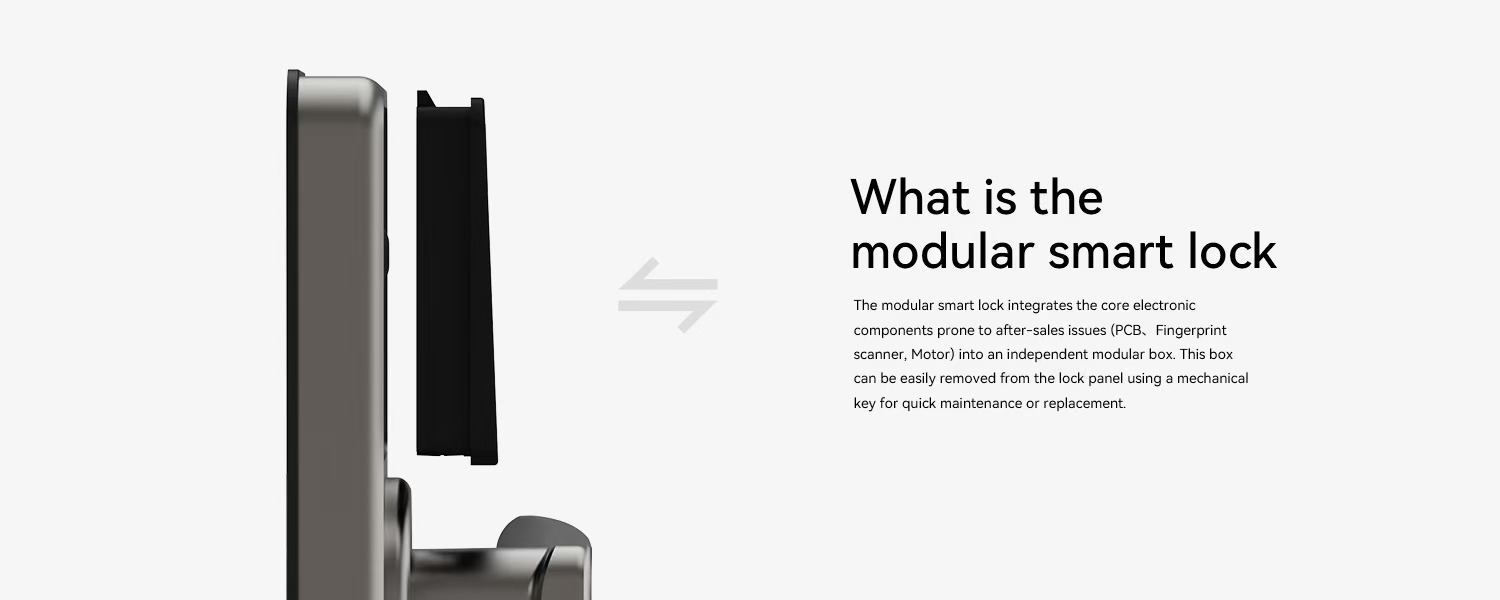
Trueway was engineered around a different answer: a patented key-swappable structure with multi-country patent protection (US 12,499,723 B1 · DE202025001780 · CN201610502753). The same mechanical key that opens the door also services the lock. Turn it right to unlock. Turn it left 90°, and the front-panel module — fingerprint reader, keypad, card reader, firmware — releases and slides out as one unit. A spare module slides in. The whole operation takes under 10 seconds, needs no tools, and the lock body stays on the door.
The most useful way to think about this mechanism is as insurance built into every lock you sell. On good days, nobody thinks about it — the lock opens, the customer is happy, the module does its job quietly. On bad days, it is the difference between a 10-second swap and a multi-day service event. You hope the customer never needs it. When they do, the "repair" is a $15–$45 module in a courier envelope instead of a $50–$150 technician visit. That is how the design is engineered to cut after-sales service visits by up to 80% — not by making parts cheaper, but by removing the visit itself.
When a Lock Fails: Integrated vs. Key-Swappable
| Conventional Integrated Lock | Trueway Key-Swappable Lock | |
|---|---|---|
| First response | Schedule a technician; the customer waits days | On-site staff or the end user swaps the module in under 10 seconds |
| The door | Lock removed; opening left unsecured or refitted with a temporary lock | Lock body stays on the door; back in service immediately |
| Spare parts | Complete spare locks on the shelf | Small modules at $15–$45 that ship by courier |
| Cost per incident | $50–$150 per visit, plus logistics and coordination | The price of a module and postage |
| What the customer remembers | The wait | The speed |
Run the Numbers Before You Sign
The worksheet takes five minutes. Take your annual unit volume, multiply by a realistic field failure rate for your market, then multiply by your true cost per incident — labor, transport, coordination hours and shipping combined. Now add the part no spreadsheet captures: how many of those customers would buy from you again, or refer you, after a week-long wait for a locked door.
Run the same numbers on a modular platform, where most incidents end with a module in the mail instead of a technician in a van. The difference between the two totals is the margin you keep — and the reputation you keep. For OEM and white-label partners, the same structure works under your own brand: your logo on the lock, and the same 10-second service model behind it.
FAQ
How much does a typical smart lock service call cost a distributor?
Across the industry, a single incident typically runs $50–$150 once technician labor, transport and logistics are counted — before return shipping and coordination time. In regions with thin technician coverage, days of waiting add customer dissatisfaction on top of the direct cost.
Why are after-sales costs higher in emerging markets?
Qualified smart lock technicians are concentrated in a few major cities, so failures elsewhere can wait days. Heat, humidity, dust and unstable power also stress electronic components. And because end users hold the local dealer responsible, every slow repair costs reputation as well as money.
How does the key-swappable design work when a lock fails?
The same mechanical key that opens the door also services the lock. Turn it right to unlock; turn it left 90° to release the front-panel module. A spare module slides in and the swap completes in under 10 seconds, with no tools and no technician. The lock body never leaves the door.
What should a distributor stock as spare parts?
Modules, not locks. A spare module costs $15–$45, fits in a courier envelope, and covers any door running the same lock body — so a small module shelf replaces a warehouse of complete spare locks.
Does faster after-sales service really affect sales?
In markets where word of mouth drives project and retail decisions, yes. Dealers known for same-day fixes win referrals and repeat projects; dealers known for week-long waits end up competing on price alone.
Learn more: the Trueway product line · patents & certifications · 57-question B2B FAQ.
Questions about distributing TrueWay in your market?想了解在你的市场经销 TrueWay?