
The Speed Advantage: How After-Sales Response Time Becomes a Smart Lock Distributor's Competitive Edge
In the Middle East, Southeast Asia and Latin America, smart lock buyers rarely start by comparing datasheets — they ask their neighbors which dealer fixes problems fast. In markets where qualified technicians are scarce and reputation travels by word of mouth, after-sales response speed is the sharpest competitive edge a distributor can own. This article shows how a patented 10-second module swap turns same-day service from a cost center into a sales weapon.中文摘要:在中东、东南亚和拉美市场,智能锁买家很少先比参数表——他们先问邻居"哪家经销商修得快"。在技师稀缺、口碑驱动的市场里,售后响应速度是经销商最锋利的竞争武器。本文展示专利 10 秒换模块如何把"当天修好"从成本中心变成销售武器。(正文为英文)
In Word-of-Mouth Markets, Response Speed Is the Brand
In mature markets, buyers compare brands. In the Middle East, Southeast Asia and Latin America — some of the fastest-growing smart lock regions in the world — buyers compare dealers. A property manager in Jeddah, a hotel owner in Da Nang, a developer in Monterrey: before they ask about fingerprint capacity or app features, they ask someone they trust a simpler question. If this lock breaks, who shows up, and how fast?
The reason is structural. Qualified smart lock technicians are concentrated in a handful of major cities, so a failure outside those hubs can mean days of waiting. When every dealer sells similar hardware at similar prices, response time becomes the visible difference. The dealer known for same-day fixes collects referrals and repeat project business. The dealer known for week-long waits ends up competing on price alone — and price-only competition compresses dealer margin year after year.
Why Conventional Smart Locks Make "Fast" Structurally Slow
Most distributors try to solve response speed with operations: service hotlines, technician partnerships, spare locks in the van. All of it helps at the edges, because the real bottleneck sits inside the product. In a conventional smart lock, the electronics, the reader and the firmware are fused into one sealed unit. Any fault in any subsystem takes the whole lock out of service. There is no field repair, only replacement.
That single design decision dictates your service timeline. Someone qualified has to travel to the door. The lock has to come off. The opening has to be secured or fitted with a temporary lock. The unit ships back and waits its turn. Across the industry, a single service call typically costs $50–$150 once labor, transport and logistics are counted — and in technician-scarce regions the calendar cost hurts more than the invoice: days in which your customer retells the story of a broken door and a missing dealer.
The 10-Second Module Swap: Anyone Can Be the Technician
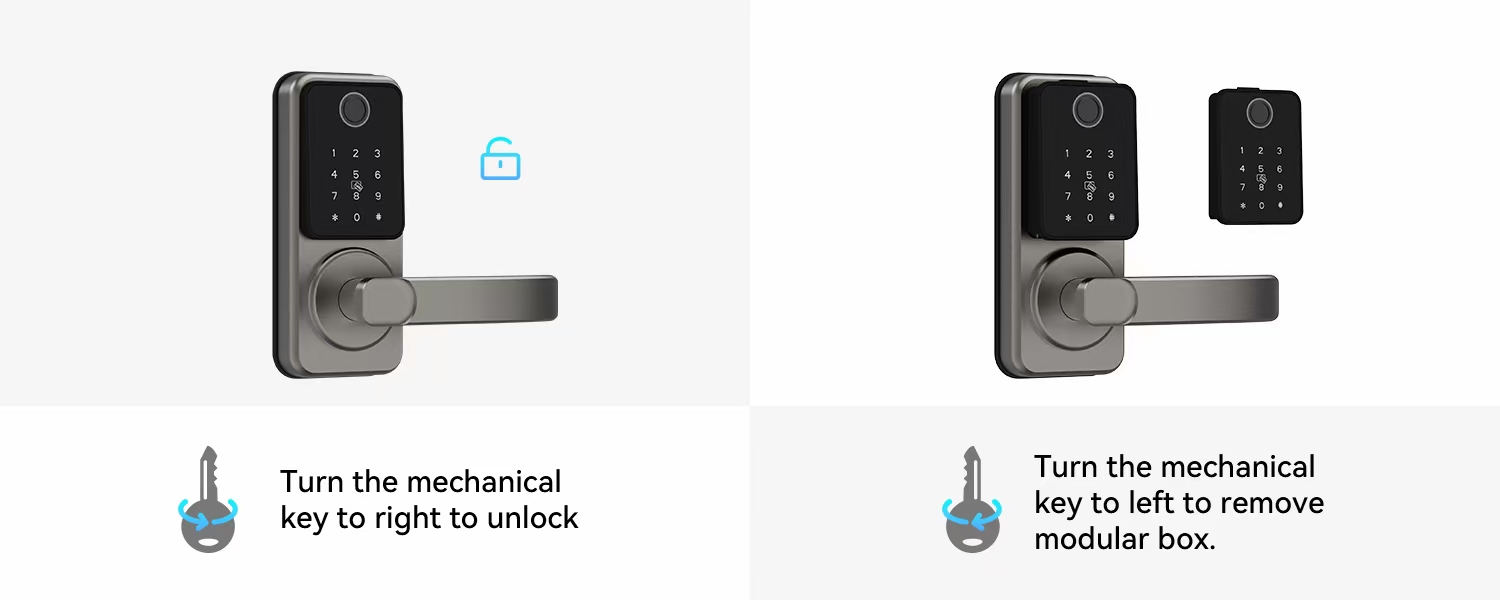
Trueway was engineered around a different answer: a patented key-swappable structure with multi-country patent protection (US 12,499,723 B1 · DE202025001780 · CN201610502753). The same mechanical key that opens the door also services the lock. Turn it right to unlock. Turn it left 90°, and the front-panel module — fingerprint reader, keypad, card reader, firmware — releases and slides out as one unit. A spare module slides in. The whole operation takes under 10 seconds, needs no tools, and the lock body stays on the door.
The commercial consequence is bigger than the mechanics: the skill requirement disappears. A repair no longer needs a technician — your own sales rep, the property's facility staff, or the end user can do it with the key already in their pocket. A "repair" becomes a $15–$45 module in a courier envelope instead of a $50–$150 technician visit. That is how the design is engineered to cut after-sales service visits by up to 80% — and why same-day service stops being an aspiration and becomes your standard answer.
The Service Race, Side by Side
| Conventional Integrated Lock | Trueway Key-Swappable Lock | |
|---|---|---|
| Who can fix it | Only a qualified technician | Your staff, facility staff or the end user — with a key |
| Typical response | Days in technician-scarce regions | Same day; often within the hour |
| Cost per incident | $50–$150 per visit, plus logistics | A $15–$45 module and postage |
| The door | Lock removed; opening secured or refitted | Lock body stays on the door |
| What the market hears | "They take weeks" | "They fix it the same day" |
Selling Speed: Turning After-Sales Into a Sales Weapon
Once same-day service is operationally real, it belongs in your sales pitch. Lead with it in project bids: a hotel or apartment developer comparing two quotes will weigh a same-day-fix commitment against a few dollars of unit price — and the commitment usually wins, because downtime costs them more than hardware does. Put it in writing as a service-level promise your competitors cannot match without a modular product behind them.
Then let the installed base do the marketing. Every fast fix is a story the customer retells — to the next property manager, the next contractor, the next developer. In referral-driven markets, that story is worth more than any advertisement, and it points at you. For OEM and white-label partners, the same structure works under your own logo: your brand on the lock, your name attached to the speed.
There is a margin effect too. Service visits are the leak through which dealer margin escapes after the sale; removing most of them protects the profit you negotiated at the front end. And every module you ship is a small, profitable transaction that keeps the relationship warm.
FAQ
How fast is fast enough for after-sales service in emerging markets?
Buyers judge you against the local norm, and in most emerging markets the norm is measured in days. A dealer who reliably resolves a lock failure the same day — or within the hour on project sites — stands out immediately. With a key-swappable lock, same-day resolution becomes a logistics question, not a staffing question.
Can an end user really swap the module themselves?
Yes. The same key that opens the door releases the module: turn right to unlock, turn left 90° and the front-panel module slides out. A spare slides in. The swap takes under 10 seconds, needs no tools, and the lock body stays on the door. Many distributors still send a staff member for the customer relationship — but the option changes the economics entirely.
What does a spare module cost compared with a technician visit?
A replacement module runs $15–$45 depending on configuration. A single conventional service call typically costs $50–$150 once technician labor, transport and logistics are counted — before return shipping and coordination time. One avoided visit often pays for a small shelf of spare modules.
How does response speed affect smart lock dealer margins?
Two ways. Directly: fewer technician visits mean lower service cost per installed unit, which protects the margin agreed at the time of sale. Indirectly: in word-of-mouth markets, a reputation for fast fixes wins referrals and repeat project business at full price, instead of forcing price-only competition for every new deal.
Does the key-swappable service model work for OEM and white-label partners?
Yes. The patented structure ships under your own brand: your logo on the lock, your packaging, your channel. Your customers experience the same 10-second module swap, and your after-sales operation runs on the same module economics — a genuine point of differentiation rather than another me-too lock.
Learn more: the Trueway product line · patents & certifications · 57-question B2B FAQ.
Questions about distributing TrueWay in your market?想了解在你的市场经销 TrueWay?