Smart Lock Manufacturer in China: An OEM/ODM Buyer's Guide for Distributors
Choosing a smart lock manufacturer in China is a multi-year margin decision: the factory you sign with sets your product differentiation, your after-sales cost and your inventory risk for the life of the line. This guide compares OEM, ODM and white-label sourcing, lists what to audit before you sign, and shows why a patented key-swappable modular design changes the economics in the buyer's favor.中文摘要:在中国选择智能锁制造商是一项影响多年利润的决定——你签约的工厂将决定产品差异化、售后成本与库存风险。本文对比 OEM、ODM 与白牌贴牌三种模式,列出签约前的审核要点,并解释专利钥匙换模块设计如何改变买家的经济账。(正文为英文)
OEM vs. ODM vs. White Label: Which Model Fits Your Business
The three sourcing models are not interchangeable, and the right choice depends on where your business earns its margin. In an OEM arrangement, you bring the design — industrial design, feature set, firmware requirements — and the factory builds to your specification. You get maximum control and maximum differentiation, but you also carry the development cost, the tooling investment and the engineering risk. OEM suits large buyers with in-house product teams.
In an ODM arrangement, the factory brings a proven platform and you brand it, configure it and sell it as your own. Development risk largely disappears, time to market is measured in weeks rather than quarters, and your differentiation depends on how distinctive the underlying platform is. For most distributors and project contractors, ODM on a differentiated platform is the commercial sweet spot.
White label — a public-mold product with your logo on it — is the fastest and cheapest route, and the most dangerous. The same mold is sold to every buyer who asks, so the only competitive lever left is price. Unless you compete on volume alone, a public-mold white-label line tends to compress your margin from the day it launches.
What to Audit Before You Sign
Start with certificates, and ask for originals rather than screenshots. For the US market that means FCC-ID; for the EU, CE-RED. Verify the certificate numbers in the issuing bodies' public databases and confirm the certificate holder matches the company you are contracting with.
Next, patents. A patent claim in a brochure is marketing; a verifiable patent number is an asset. Trueway's key-swappable modular structure, for example, is covered by US 12,499,723 B1, DE202025001780 and CN201610502753, with design patents CN202630085403 and CN202630085870 — multi-country patent protection you can check before signing. Patents matter commercially because a protected structure is a feature your competitors cannot legally copy.
Then the QC process. Ask what testing is done in-house and walk the line if you can. At Trueway's 2,500㎡ factory in Zhongshan, Guangdong — Guangzhou Runfu Biotechnology Co., Ltd, founded 2015 — every lock goes through aging tests, salt-spray tests and high/low-temperature tests before shipment. Be wary of factories that claim to do everything: Trueway focuses on mechanical structure, final assembly and testing, and sources electronic modules from qualified suppliers rather than assembling circuit boards in-house. That honest division of labor is a sign of a factory that knows where reliability is actually won.
The Cost Structure Nobody Puts in the Quote
The unit price on a quotation is the beginning of your cost, not the end. Across the industry, a single on-site service visit typically costs $50–$150 once labor, transport and scheduling are counted — and in a conventional smart lock, any electronic fault means exactly that visit, because the electronics are sealed into one unit with no field repair option.
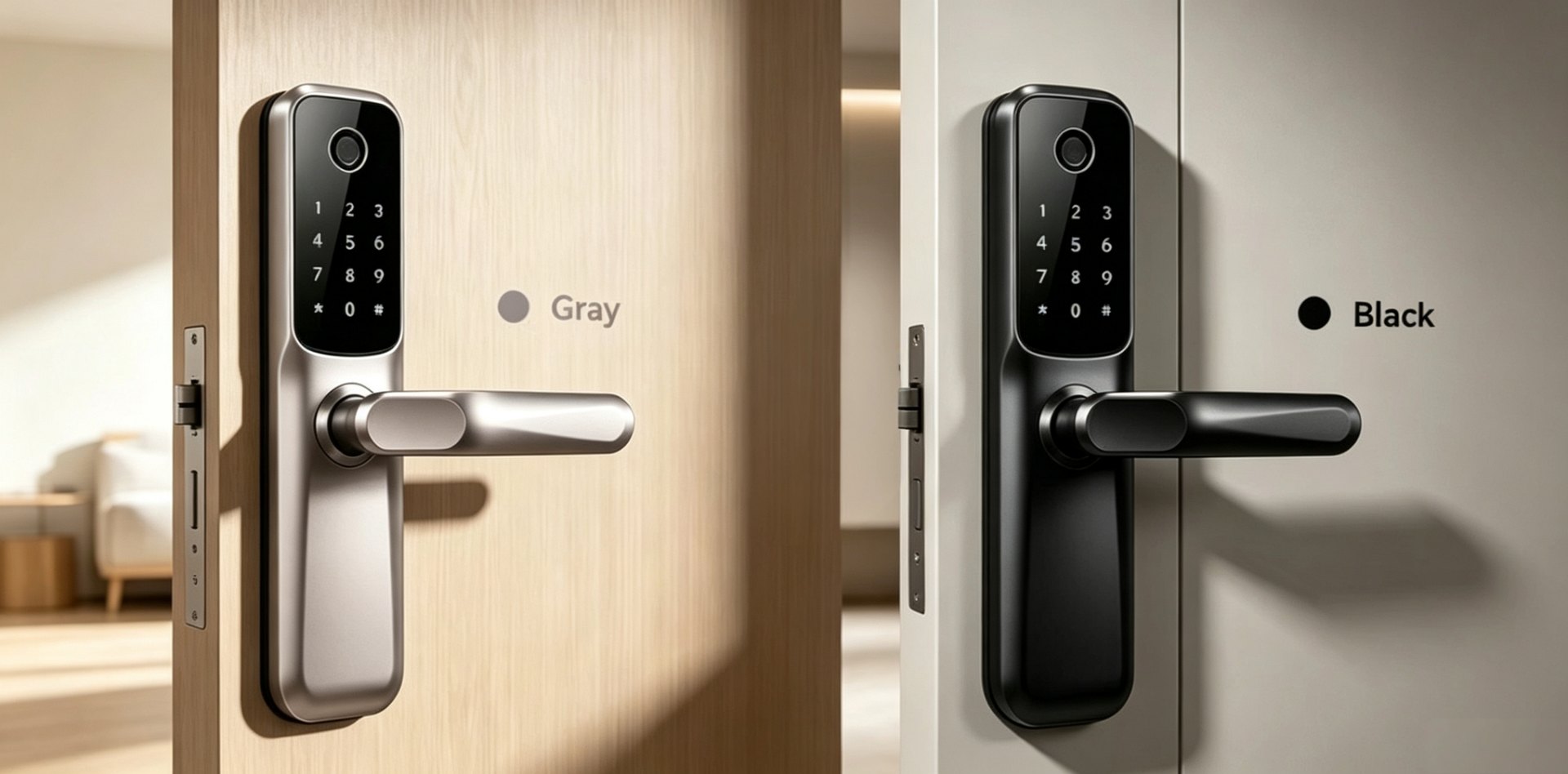
A key-swappable modular design inverts this. On the Trueway RF-2, the front-panel module — fingerprint reader, keypad, card reader, firmware — releases with a 90° turn of the mechanical key and swaps in under 10 seconds. A replacement module costs $15–$45, versus $50–$150 for one on-site service visit, and no technician visit or whole-lock return is needed. The structure is designed to cut after-sales service visits by up to 80%. Or as the product principle puts it: The Lock Stays. Only the Module Travels.
SKU Efficiency: Stock Modules, Not Locks
Inventory is the second hidden cost. A conventional product line forces you to stock separate lock SKUs for every feature combination — fingerprint, card-only, face recognition — and each unsold variant ties up capital. With a modular platform, one lock body covers the range and the feature set lives in the module. Your warehouse holds one body plus a handful of low-cost module SKUs: Stock Modules, Not Locks. The same structure also turns every installed lock into future module revenue — upgrades, reconfigurations and spares all flow through the distributor who placed the original units.
MOQ, Lead Time and Customization
Serious factories support private label buyers with logo engraving or printing, custom packaging and manuals, app interface branding, and module-level feature configuration. Before you commit, get four things in writing: the MOQ for each customization level, the sample policy and sample lead time, the production lead time at your expected order size, and the warranty process for defective units. A factory that answers these four questions precisely is a factory that has served export buyers before.
Public-Mold Factory vs. Patented Modular Manufacturer
| Typical Public-Mold Factory | Patented Modular Manufacturer | |
|---|---|---|
| Product differentiation | Same mold sold to every buyer; logo is the only difference | Patented key-swappable structure competitors cannot legally copy |
| After-sales cost driver | Technician visit at $50–$150 per failure | Module swap in under 10 seconds with a key; module at $15–$45 |
| Inventory requirement | Separate lock SKUs per feature set | One lock body plus low-cost module SKUs |
| Price-war exposure | High — identical products compete on price alone | Lower — patented differentiation supports pricing power |
| Patent protection | None or unverifiable claims | Multi-country patent protection with verifiable numbers |
FAQ
What is the difference between OEM and ODM for smart locks?
With OEM, you supply the design and the factory builds to your specification. With ODM, the factory supplies a proven product platform that you brand and configure as your own. Most distributors get the best balance of speed, cost and differentiation from an ODM or private-label arrangement on a patented platform.
How do I verify a smart lock factory's certifications?
Ask for the original FCC-ID (US) and CE-RED (EU) certificates, then check the certificate numbers in the issuing bodies' public databases. The certificate holder should match the factory or brand you are signing with.
Why do patents matter when choosing a smart lock manufacturer?
A patented structure gives you a feature competitors cannot legally copy, which supports healthier pricing and reduces direct price-war exposure. Ask for verifiable patent numbers rather than marketing claims.
How does a key-swappable module reduce after-sales cost?
Instead of a technician visit at $50–$150, a failed front-panel module is swapped with a key in under 10 seconds, and a replacement module costs $15–$45. The structure is designed to cut after-sales service visits by up to 80%.
What customization can a smart lock factory offer for private label orders?
Typical options include logo engraving or printing, custom packaging and manuals, app interface branding, and module-level feature configuration. Confirm sample policy, MOQ tiers and lead times in writing before placing a volume order.
Learn more: full product line · factory & QC process · patents & certifications · B2B FAQ.
Planning an OEM/ODM or private label smart lock line for your market?正在为你的市场规划 OEM/ODM 或贴牌智能锁产品线?