
Stock Modules, Not Locks: Smarter Spare Parts Inventory for Smart Lock Distributors
Ask a smart lock distributor where their profit sleeps, and the honest answer is often: on the warehouse shelf. Conventional after-sales planning demands complete spare locks — several per model — tying up working capital and multiplying SKUs. There is a leaner model: stock a handful of $15–$45 swappable modules instead of entire locks, and cover every after-sales scenario with inventory that fits in a courier envelope.中文摘要:问智能锁经销商利润睡在哪里,诚实的答案往往是:仓库货架上。传统售后备货要求备整锁——每个型号好几台——占压资金、SKU 翻倍。有一种更轻的模式:只备几种 $15–$45 的可换模块而不是整锁,用一个快递信封大小的库存覆盖全部售后场景。(正文为英文)
The Warehouse Line Item Nobody Puts in the Business Plan
Every distributor writes a business plan around sellable inventory: the locks that ship out and generate revenue. Almost nobody plans honestly for the other inventory — the units that sit still. After-sales obligations mean spare units on the shelf: locks reserved for warranty swaps, locks kept as donor units for parts, returned units waiting for repair or write-off.
With conventional smart locks, the math works against you in both directions at once. Each spare unit costs as much as a sellable unit — full purchase price for hardware you hope stays on the shelf. And because different models and feature tiers are sealed, non-interchangeable products, coverage means spares for each variant you carry. The broader your product range, the deeper the shelf of dormant capital behind it.
Why Conventional Locks Force You to Stock Whole Locks
The root cause is the same one that drives service costs: integration. In a conventional smart lock, the electronics, the reader and the firmware are fused into one sealed unit. When any subsystem fails, the whole unit becomes the spare part. There is no smaller unit of repair — so there can be no smaller unit of inventory.
The consequences compound quietly. Spare locks sit on the shelf, and your cash sits with them. Model generations turn over, and last year's spares drift toward obsolescence while still on your books. Warehouse space that could hold sellable stock holds insurance instead. And every SKU you add for coverage adds counting, tracking and reordering work to your back office.
One Lock Body, a Small Shelf of Modules
Trueway's patented key-swappable structure (US 12,499,723 B1 · DE202025001780 · CN201610502753), with multi-country patent protection, moves the failure boundary. The lock body — mortise, handle, mechanical core — stays on the door. The electronics live in a front-panel module that the same mechanical key releases with a 90° left turn. The module slides out, a spare slides in, and the swap completes in under 10 seconds with no tools.
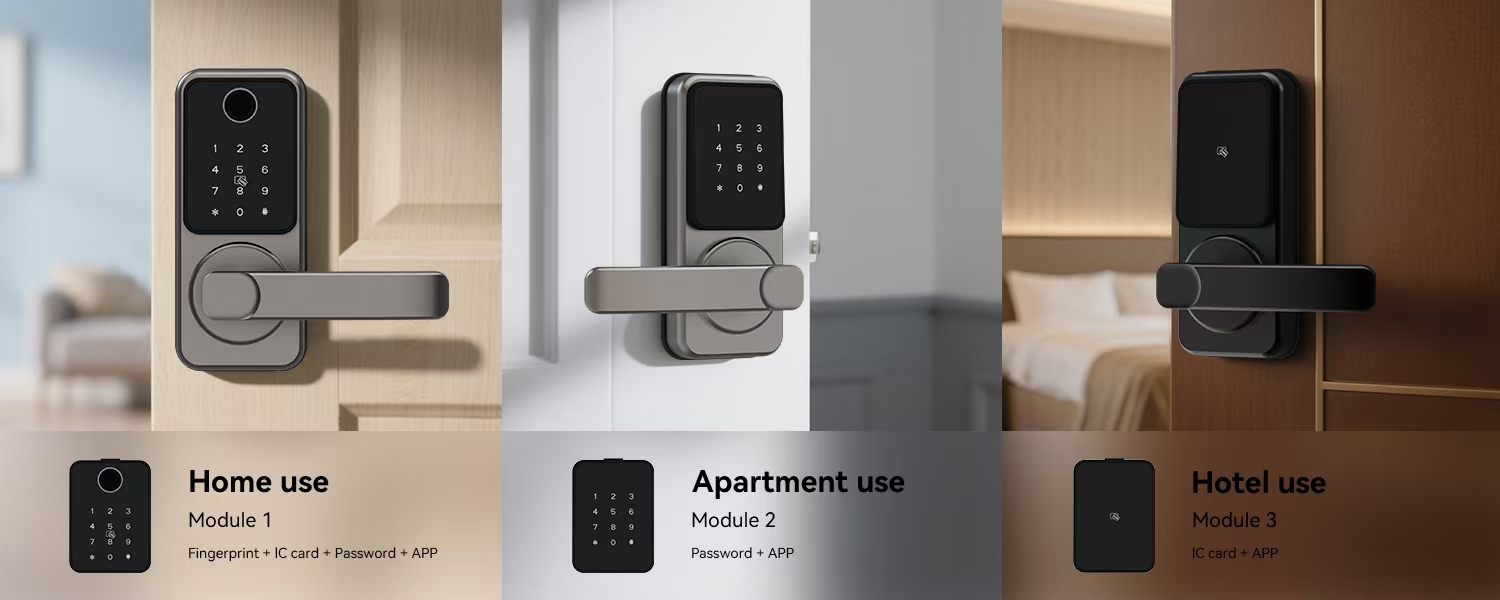
For inventory planning, this changes the unit of account. The part that fails is the part you stock — and that part costs $15–$45, fits in a courier envelope, and covers any door running the same lock body. Because one lock body accepts multiple module configurations, a handful of module SKUs covers your entire installed base: every project, every feature tier, every finish. The warehouse of complete spare locks shrinks to a shelf — often a drawer — of modules.
Spare Parts Strategy, Side by Side
| Complete Spare Locks | Swappable Modules | |
|---|---|---|
| Unit cost of a spare | Full lock price | $15–$45 per module |
| Coverage per SKU | One model, one feature tier | Every door on the same lock body |
| Shelf space | Cartons of complete locks | A padded envelope per module |
| Shipping to site | Parcel freight, lock-sized | Standard courier envelope |
| Obsolescence risk | Tied to model generations | Modules follow the platform, not the model year |
| What else the stock can do | Repairs only | Repairs, feature upgrades, reconfigurations |
What Lean Inventory Does to Cash Flow and Margin
The first effect is released working capital. Money that sat in spare locks returns to sellable stock, to marketing, or simply to the bank balance — and for most distributors, freed cash earns more in sellable inventory than it ever did as insurance. The second effect is simplicity: fewer spare-part SKUs mean less counting, less tracking, less reorder administration, and far less capital exposed when product generations turn over.
The third effect is new revenue. The same module shelf that covers failures also covers upgrades: a residential customer moving to a richer feature set, a hotel converting floors to a leaner configuration, a landlord reconfiguring units between tenants. Each of those is a module sale through your channel — the installed base you placed keeps generating repeat business without a single new lock leaving the warehouse. Combined with a design that is engineered to cut after-sales service visits by up to 80%, lean inventory turns after-sales from a cost you fund into a margin stream you keep.
For OEM and white-label partners, the arithmetic holds under your own brand: one lock body in your catalog, a short list of module SKUs behind it, and a spare-parts operation that fits in a filing cabinet rather than a warehouse bay.
FAQ
How many module SKUs do I need to cover my whole installed base?
Far fewer than lock SKUs. Because one lock body accepts multiple module configurations, the modules you stock are defined by feature sets rather than by models. Most distributors cover their entire after-sales obligation with a short list of module SKUs — one per configuration they sell — instead of spare units for every model and finish in the catalog.
How much working capital does module-based inventory free up?
Run your own comparison: count the complete spare locks you currently hold, multiply by their unit cost, and compare with the same coverage in modules at $15–$45 each. For most distributors the difference is an order of magnitude — capital that can return to sellable stock, and shelf space that returns to revenue-generating inventory.
Do modules cover upgrades as well as failures?
Yes. The module defines the feature set, so the same swap that repairs a fault can also change what a lock does. Customers moving between feature tiers, landlords reconfiguring units between tenants, hotels standardizing floors — each becomes a module sale instead of a full lock replacement.
How does module inventory work for project installations?
Project buyers typically keep a small module stock on site as part of the handover. When a unit fails, facility staff swap the module in under 10 seconds with the mechanical key — the door stays in service, and the faulty module returns by courier. Downtime clauses in project contracts become much easier to honor.
Can OEM and white-label partners use the same module system?
Yes. The platform ships under your own brand: one lock body in your catalog, your logo on the hardware, and the same module-based spare-parts economics behind it. Your service operation inherits the same envelope-sized inventory model at $15–$45 per module.
Learn more: the Trueway product line · patents & certifications · 57-question B2B FAQ.
Questions about distributing TrueWay in your market?想了解在你的市场经销 TrueWay?